Appearance
什么是状态管理
在开发中,我们会的应用程序需要处理各种各样的数据,这些数据需要保存在我们应用程序中的某一个位置,对于这些数据的管理我们就称之为是状态管理。
在前面我们是如何管理自己的状态呢?
在 Vue 开发中,我们使用组件化的开发方式;
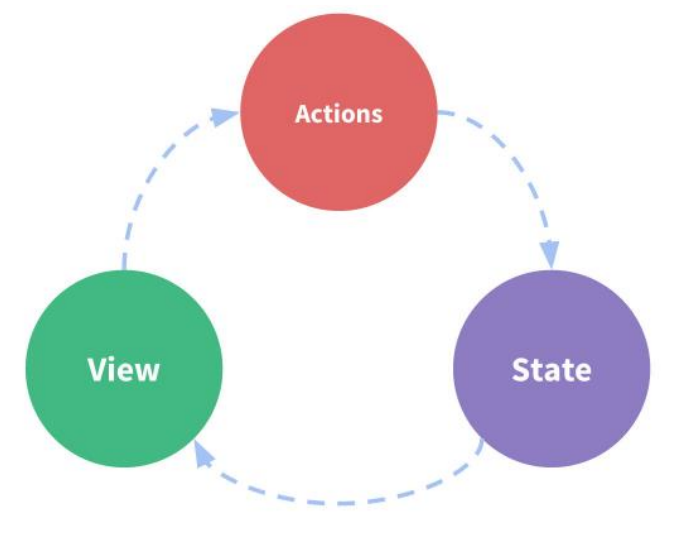
而在组件中我们定义 data 或者在 setup 中返回使用的数据,这些数据我们称之为 state;
在模块 template 中我们可以使用这些数据,模块最终会被渲染成 DOM,我们称之为 View;
在模块中我们会产生一些行为事件,处理这些行为事件时,有可能会修改 state,这些行为事件我们称之为 actions;
复杂的状态管理
JavaScript 开发的应用程序,已经变得越来越复杂了:
JavaScript 需要管理的状态越来越多,越来越复杂;
这些状态包括服务器返回的数据、缓存数据、用户操作产生的数据等等;
也包括一些 UI 的状态,比如某些元素是否被选中,是否显示加载动效,当前分页;
当我们的应用遇到多个组件共享状态时,单向数据流的简洁性很容易被破坏:
多个视图依赖于同一状态;
来自不同视图的行为需要变更同一状态;
我们是否可以通过组件数据的传递来完成呢?
对于一些简单的状态,确实可以通过 props 的传递或者 Provide 的方式来共享状态;
但是对于复杂的状态管理来说,显然单纯通过传递和共享的方式是不足以解决问题的,比如兄弟组件如何共享数据呢?
Vuex 的状态管理
管理不断变化的 state 本身是非常困难的:
状态之间相互会存在依赖,一个状态的变化会引起另一个状态的变化,View 页面也有可能会引起状态的变化;
当应用程序复杂时,state 在什么时候,因为什么原因而发生了变化,发生了怎么样的变化,会变得非常难以控制和追踪;
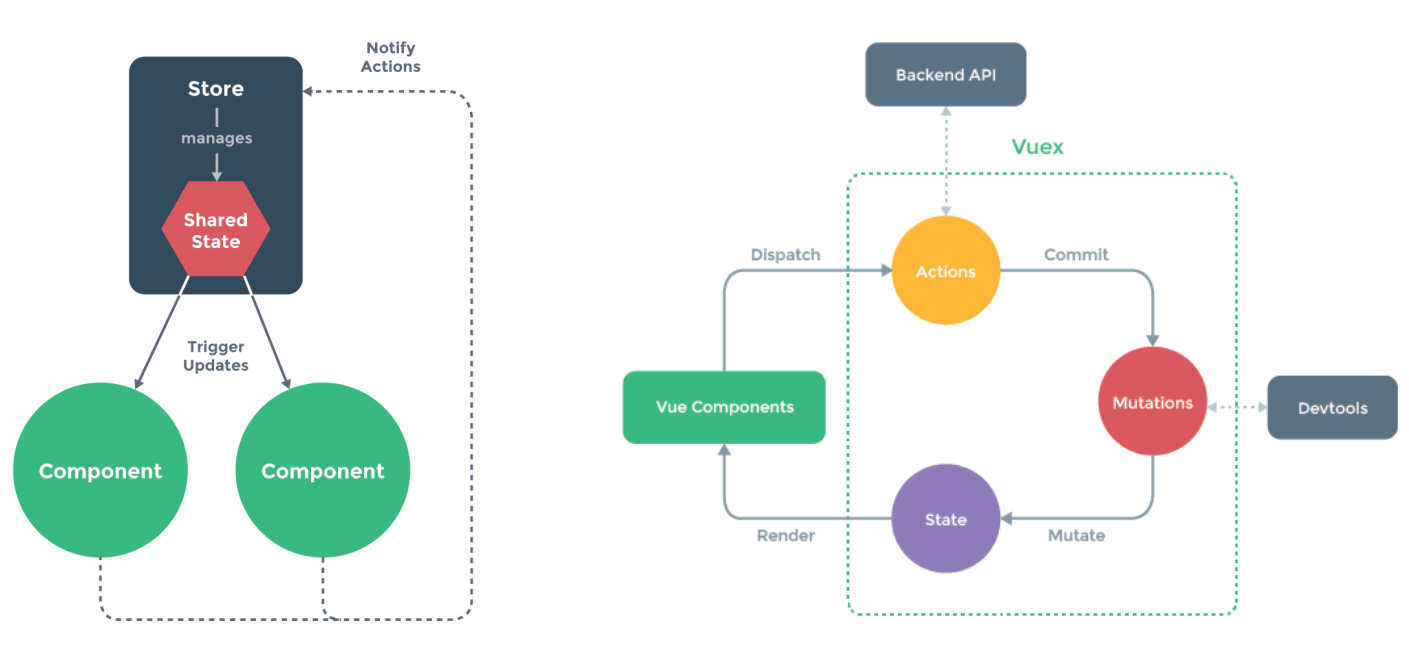
因此,我们是否可以考虑将组件的内部状态抽离出来,以一个全局单例的方式来管理呢?
在这种模式下,我们的组件树构成了一个巨大的 “试图 View”;
不管在树的哪个位置,任何组件都能获取状态或者触发行为;
通过定义和隔离状态管理中的各个概念,并通过强制性的规则来维护视图和状态间的独立性,我们的代码边会变得更加结构化和易于维护、跟踪;
这就是 Vuex 背后的基本思想,它借鉴了 Flux、Redux、Elm(纯函数语言,redux 有借鉴它的思想);
当然,目前 Vue 官方也在推荐使用 Pinia 进行状态管理,我们后续也会进行学习。
Vuex 的安装和基本使用
依然我们要使用 vuex,首先第一步需要安装 vuex:
我们这里使用的是 vuex4.x;
javascript
npm install vuexstore/index.js
javascript
import { createStore } from "vuex";

const store = createStore({
  state: () => ({
    // 模拟数据
    counter: 100,
  }),
});

export default store;
main.js
javascript
import { createApp } from "vue";
import App from "./App.vue";
import store from "./store";

createApp(App).use(store).mount("#app");
App.vue
javascript
<template>
  <div class="app">
    <!-- store中的counter -->
    <h2>App当前计数: {{ $store.state.counter }}</h2>
  </div>
</template>

<script setup>
</script>

<style>
</style>
创建 Store
每一个 Vuex 应用的核心就是 store(仓库):
store 本质上是一个容器,它包含着你的应用中大部分的状态(state);
Vuex 和单纯的全局对象有什么区别呢?
第一:Vuex 的状态存储是响应式的
当 Vue 组件从 store 中读取状态的时候,若 store 中的状态发生变化,那么相应的组件也会被更新;
第二:你不能直接改变 store 中的状态
改变 store 中的状态的唯一途径就显示提交 (commit) mutation;
这样使得我们可以方便的跟踪每一个状态的变化,从而让我们能够通过一些工具帮助我们更好的管理应用的状态;
使用步骤:
创建 Store 对象;
在 app 中通过插件安装,就是 app.use(store);
组件中使用 store
在组件中使用 store,我们按照如下的方式:
在模板中使用;
在 options api 中使用,比如 computed;
在 setup 中使用;
javascript
<template>
  <div class="app">
    <h2>Home当前计数: {{ $store.state.counter }}</h2>
    <h2>Computed当前计数: {{ storeCounter }}</h2>
    <h2>Setup当前计数: {{ counter }}</h2>
    <button @click="increment">+1</button>
  </div>
</template>

<script>
  export default {
    computed: {
      storeCounter() {
        return this.$store.state.counter
      }
    }
  }
</script>

<script setup>
  import { toRefs } from 'vue'
  import { useStore } from 'vuex'

  const store = useStore()
  const { counter } = toRefs(store.state) // 使用toRefs结构出来的counter才是响应式的

  function increment() {
    // store.state.counter++ // 不推荐
    store.commit("increment") // 改变store中的状态的唯一途径就显示提交 (commit) mutation
  }
</script>

<style scoped>
</style>
store/index.js
javascript
...
mutations: {
    increment(state) {
      state.counter++
    },
}
单一状态树
Vuex 使用单一状态树:
用一个对象就包含了全部的应用层级的状态;
采用的是 SSOT,Single Source of Truth,也可以翻译成单一数据源;
这也意味着,每个应用将仅仅包含一个 store 实例;
单状态树和模块化并不冲突,后面我们会讲到 module 的概念;
单一状态树的优势:
如果你的状态信息是保存到多个 Store 对象中的,那么之后的管理和维护等等都会变得特别困难;
所以 Vuex 也使用了单一状态树来管理应用层级的全部状态;
单一状态树能够让我们最直接的方式找到某个状态的片段;
而且在之后的维护和调试过程中,也可以非常方便的管理和维护;
组件获取状态
在前面我们已经学习过如何在组件中获取状态了。
当然,如果觉得那种方式有点繁琐(表达式过长),我们可以使用计算属性:
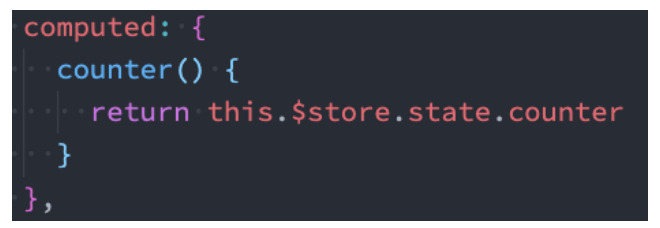
但是,如果我们有很多个状态都需要获取话,可以使用 mapState 的辅助函数:
mapState 的方式一:对象类型;
mapState 的方式二:数组类型;
也可以使用展开运算符和来原有的 computed 混合在一起;
mapState 辅助函数
在 setup 中如果我们单个获取装是非常简单的:
通过 useStore 拿到 store 后去获取某个状态即可;
但是如果我们需要使用 mapState 的功能呢?
默认情况下,Vuex 并没有提供非常方便的使用 mapState 的方式,这里我们进行了一个函数的封装:
javascript
<template>
  <div class="app">
    <button @click="incrementLevel">修改level</button>
    <!-- 1.在模板中直接使用多个状态 -->
    <h2>name: {{ $store.state.name }}</h2>
    <h2>level: {{ $store.state.level }}</h2>
    <h2>avatar: {{ $store.state.avatarURL }}</h2>

    <!-- 2.计算属性(映射状态: 数组语法) -->
    <!-- <h2>name: {{ name() }}</h2>
    <h2>level: {{ level() }}</h2> -->

    <!-- 3.计算属性(映射状态: 对象语法) -->
    <!-- <h2>name: {{ sName }}</h2>
    <h2>level: {{ sLevel }}</h2> -->

    <!-- 4.setup计算属性(映射状态: 对象语法) -->
    <!-- <h2>name: {{ cName }}</h2>
    <h2>level: {{ cLevel }}</h2> -->

    <!-- 5.setup计算属性(映射状态: 对象语法) -->
    <h2>name: {{ name }}</h2>
    <h2>level: {{ level }}</h2>
  </div>
</template>

<script>
  import { mapState } from 'vuex'

  export default {
    computed: {
      fullname() {
        return "xxx"
      },
      // name() {
      //   return this.$store.state.name
      // },
      ...mapState(["name", "level", "avatarURL"]), // mapState会返回一个对象,里面有多个函数
      ...mapState({
        sName: state => state.name, // 使用对象的方式是为了防止和data定义的名字冲突,比如data中也有个叫name的数据
        sLevel: state => state.level
      })
    }
  }
</script>

<script setup>
  import { computed, toRefs } from 'vue'
  import { mapState, useStore } from 'vuex'
  import useState from "../hooks/useState"

  // 1.一步步完成
  // const { name, level } = mapState(["name", "level"])
  // const store = useStore()
  // const cName = computed(name.bind({ $store: store }))
  // const cLevel = computed(level.bind({ $store: store }))

  // 2.使用useState
  // const { name, level } = useState(["name", "level"])

  // 3.直接对store.state进行解构(推荐)
  const store = useStore()
  const { name, level } = toRefs(store.state)

  function incrementLevel() {
    // store.state.level++ 这里只是为了测试修改level有没有生效,这种写法不推荐
  }

</script>

<style scoped>
</style>
hooks/useState
javascript
import { computed } from "vue";
import { useStore, mapState } from "vuex";

export default function useState(mapper) {
  const store = useStore();
  const stateFnsObj = mapState(mapper);

  const newState = {};
  Object.keys(stateFnsObj).forEach((key) => {
    newState[key] = computed(stateFnsObj[key].bind({ $store: store }));
  });

  return newState;
}
getters 的基本使用
某些属性我们可能需要经过变化后来使用,这个时候可以使用 getters
getters 可以接收第二个参数
getters 中的函数本身,可以返回一个函数,那么在使用的地方相当于可以调用这个函数
javascript
<template>
  <div class="app">
    <!-- <button @click="incrementLevel">修改level</button> -->
    <h2>doubleCounter: {{ $store.getters.doubleCounter }}</h2>
    <h2>friendsTotalAge: {{ $store.getters.totalAge }}</h2>
    <h2>message: {{ $store.getters.message }}</h2>

    <!-- 根据id获取某一个朋友的信息 -->
    <h2>id-111的朋友信息: {{ $store.getters.getFriendById(111) }}</h2>
    <h2>id-112的朋友信息: {{ $store.getters.getFriendById(112) }}</h2>
  </div>
</template>

<script>
  export default {
  }
</script>

<script setup>

</script>

<style scoped>
</style>
javascript
state: () => ({
    // 模拟数据
    counter: 100,
    name: "coderwhy",
    level: 100,
    avatarURL: "http://xxxxxx",
    friends: [
      { id: 111, name: "why", age: 20 },
      { id: 112, name: "kobe", age: 30 },
      { id: 113, name: "james", age: 25 }
    ],
  }),
  getters: {
    // 1.基本使用
    doubleCounter(state) {
      return state.counter * 2
    },
    totalAge(state) {
      return state.friends.reduce((preValue, item) => {
        return preValue + item.age
      }, 0)
    },
    // 2.在该getters属性中, 获取其他的getters
    message(state, getters) {
      return `name:${state.name} level:${state.level} friendTotalAge:${getters.totalAge}`
    },
    // 3.getters是可以返回一个函数的, 调用这个函数可以传入参数(了解)
    getFriendById(state) {
      return function(id) {
        const friend = state.friends.find(item => item.id === id)
        return friend
      }
    }
  },
mapGetters 的辅助函数
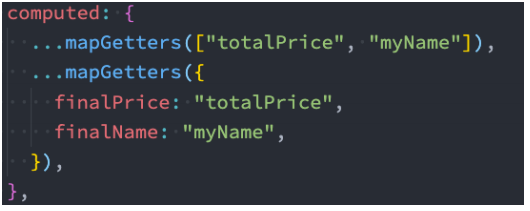
这里我们也可以使用 mapGetters 的辅助函数。
javascript
<template>
  <div class="app">
    <button @click="changeAge">修改name</button>

    <h2>doubleCounter: {{ doubleCounter }}</h2>
    <h2>friendsTotalAge: {{ totalAge }}</h2>
    <h2>message: {{ message }}</h2>

    <!-- 根据id获取某一个朋友的信息 -->
    <h2>id-111的朋友信息: {{ getFriendById(111) }}</h2>
    <h2>id-112的朋友信息: {{ getFriendById(112) }}</h2>
  </div>
</template>

<script>
  import { mapGetters } from 'vuex'

  export default {
    computed: {
      ...mapGetters(["doubleCounter", "totalAge"]),
      ...mapGetters(["getFriendById"])
    }
  }
</script>

<script setup>

  import { computed, toRefs } from 'vue';
  import { mapGetters, useStore } from 'vuex'

  const store = useStore()

  // 1.使用mapGetters
  // const { message: messageFn } = mapGetters(["message"])
  // const message = computed(messageFn.bind({ $store: store }))

  // 2.直接解构, 并且包裹成ref
  // const { message } = toRefs(store.getters)

  // 3.针对某一个getters属性使用computed
  const message = computed(() => store.getters.message)

  function changeAge() {
    store.state.name = "kobe" // 不推荐这么写,这里只是为了测试响应式
  }

</script>

<style scoped>
</style>
Mutation 基本使用
更改 Vuex 的 store 中的状态的唯一方法是提交 mutation:
很多时候我们在提交 mutation 的时候,会携带一些数据,这个时候我们可以使用参数
javascript
<template>
  <div class="app">
    <button @click="changeName">修改name</button>
    <button @click="incrementLevel">递增level</button>
    <button @click="changeInfo">修改info</button>
    <h2>Store Name: {{ $store.state.name }}</h2>
    <h2>Store Level: {{ $store.state.level }}</h2>
  </div>
</template>

<script>

  export default {
    computed: {
    },
    methods: {
      changeName() {
        // this.$store.state.name = "李银河"
        this.$store.commit("changeName", "王小波") // 传一个字符串参数
      },
      incrementLevel() {
        this.$store.commit("incrementLevel")
      },
      changeInfo() { // 传一个对象参数
        this.$store.commit("changeInfo", {
          name: "王二",
          level: 200
        })
      }
    }
  }
</script>

<script setup>

</script>

<style scoped>
</style>
javascript
mutations: {
    increment(state) {
      state.counter++
    },
    changeName(state, payload) {
      state.name = payload
    },
    incrementLevel(state) {
      state.level++
    },
    changeInfo(state, newInfo) {
      state.level = newInfo.level
      state.name = newInfo.name
    },
}
对象风格的提交方式,了解即可
javascript
$store.commit({
  type: "addNumber",
  count: 100,
});
Mutation 常量类型
定义常量:mutation-type.js
定义 mutation
提交 mutation
mutation_types.js
javascript
export const CHANGE_INFO = "changeInfo";store/index.js
javascript
import { CHANGE_INFO } from './mutation_types'

...
mutations: {
    // 定义mutation
    [CHANGE_INFO](state, newInfo) {
      state.level = newInfo.level
      state.name = newInfo.name
    },
}
App.vue
javascript
<script>

  import { CHANGE_INFO } from "@/store/mutation_types"

  export default {
    methods: {
      changeInfo() { // 提交mutation
        this.$store.commit(CHANGE_INFO, {
          name: "王二",
          level: 200
        })
      }
    }
  }
</script>
mapMutations 辅助函数
我们也可以借助于辅助函数,帮助我们快速映射到对应的方法中
javascript
<template>
  <div class="app">
    <button @click="changeName('王小波')">修改name</button>
    <button @click="incrementLevel">递增level</button>
    <button @click="changeInfo({ name: '王二', level: 200 })">修改info</button>
    <h2>Store Name: {{ $store.state.name }}</h2>
    <h2>Store Level: {{ $store.state.level }}</h2>
  </div>
</template>

<script>
  import { mapMutations } from 'vuex'
  import { CHANGE_INFO } from "@/store/mutation_types"

  export default {
    computed: {
    },
    methods: {
      btnClick() {
        console.log("btnClick")
      },
      // ...mapMutations(["changeName", "incrementLevel", CHANGE_INFO])
    }
  }
</script>

<script setup>

  import { mapMutations, useStore } from 'vuex'
  import { CHANGE_INFO } from "@/store/mutation_types"

  const store = useStore()

  // 1.手动的映射和绑定
  const mutations = mapMutations(["changeName", "incrementLevel", CHANGE_INFO])
  const newMutations = {}
  Object.keys(mutations).forEach(key => {
    newMutations[key] = mutations[key].bind({ $store: store })
  })
  const { changeName, incrementLevel, changeInfo } = newMutations

</script>

<style scoped>
</style>
mutation 重要原则
一条重要的原则就是要记住 mutation 必须是同步函数
这是因为 devtool 工具会记录 mutation 的日记;
每一条 mutation 被记录,devtools 都需要捕捉到前一状态和后一状态的快照;
但是在 mutation 中执行异步操作,就无法追踪到数据的变化;
所以 Vuex 的重要原则中要求 mutation 必须是同步函数;
但是如果我们希望在 Vuex 中发送网络请求的话需要如何操作呢?
actions 的基本使用
Action 类似于 mutation,不同在于:
Action 提交的是 mutation,而不是直接变更状态;
Action 可以包含任意异步操作;
这里有一个非常重要的参数 context:
context 是一个和 store 实例均有相同方法和属性的 context 对象,但是不等于 store;
所以我们可以从其中获取到 commit 方法来提交一个 mutation,或者通过 context.state 和 context.getters 来获取 state 和
getters;
但是为什么它不是 store 对象呢?这个等到我们讲 Modules 时再具体来说;
actions 的分发操作
如何使用 action 呢?进行 action 的分发:
javascript
this.$store.dispatch("increment");分发使用的是 store 上的 dispatch 函数;
同样的,它也可以携带我们的参数:
javascript
this.$store.dispatch("increment", { count: 100 });也可以以对象的形式进行分发:
javascript
this.$store.dispatch({
  type: "increment",
  count: 100,
});
javascript
<template>
  <div class="home">
    <h2>当前计数: {{ $store.state.counter }}</h2>
    <button @click="counterBtnClick">发起action修改counter</button>
    <h2>name: {{ $store.state.name }}</h2>
    <button @click="nameBtnClick">发起action修改name</button>
  </div>
</template>

<script>

  export default {
    methods: {
      counterBtnClick() {
        this.$store.dispatch("incrementAction")
      },
      nameBtnClick() {
        this.$store.dispatch("changeNameAction", "aaa")
      }
    }
  }
</script>

<script setup>

</script>

<style scoped>
</style>
javascript
mutations: {
    increment(state) {
      state.counter++
    },
    changeName(state, payload) {
      state.name = payload
    },
},
actions: {
    incrementAction(context) {
      // console.log(context.commit) // 用于提交mutation
      // console.log(context.getters) // getters
      // console.log(context.state) // state
      context.commit("increment")
    },
    changeNameAction(context, payload) {
      context.commit("changeName", payload)
    },
}
mapActions 辅助函数
action 也有对应的辅助函数:
对象类型的写法;
数组类型的写法;

javascript
<template>
  <div class="home">
    <h2>当前计数: {{ $store.state.counter }}</h2>
    <button @click="incrementAction">发起action修改counter</button>
    <button @click="increment">递增counter</button>
    <h2>name: {{ $store.state.name }}</h2>
    <button @click="changeNameAction('bbbb')">发起action修改name</button>
  </div>
</template>

<script>
  import { mapActions } from 'vuex'

  export default {
    methods: {
      // counterBtnClick() {
      //   this.$store.dispatch("incrementAction")
      // },
      // nameBtnClick() {
      //   this.$store.dispatch("changeNameAction", "aaa")
      // }
      // ...mapActions(["incrementAction", "changeNameAction"])
    }
  }
</script>

<script setup>

  import { useStore, mapActions } from 'vuex'

  const store = useStore()

  // 1.在setup中使用mapActions辅助函数
  // const actions = mapActions(["incrementAction", "changeNameAction"])
  // const newActions = {}
  // Object.keys(actions).forEach(key => {
  //   newActions[key] = actions[key].bind({ $store: store })
  // })
  // const { incrementAction, changeNameAction } = newActions

  // 2.使用默认的做法
  function increment() {
    store.dispatch("incrementAction")
  }

</script>

<style scoped>
</style>
actions 的异步操作
Action 通常是异步的,那么如何知道 action 什么时候结束呢?
我们可以通过让 action 返回 Promise,在 Promise 的 then 中来处理完成后的操作;
Home.vue
javascript
<template>
  <div class="home">
    <h2>Home Page</h2>
    <ul>
      <template v-for="item in $store.state.banners" :key="item.acm">
        <li>{{ item.title }}</li>
      </template>
    </ul>
  </div>
</template>

<script>
</script>

<script setup>

  import { useStore } from 'vuex'

  // 告诉Vuex发起网络请求
  const store = useStore()
  store.dispatch("fetchHomeMultidataAction").then(res => {
    console.log("home中的then被回调:", res)
  })

</script>


<style scoped>
</style>
store/index.js
javascript
import { createStore } from "vuex";

const store = createStore({
  state: () => ({
    // 服务器数据
    banners: [],
    recommends: [],
  }),
  mutations: {
    changeBanners(state, banners) {
      state.banners = banners;
    },
    changeRecommends(state, recommends) {
      state.recommends = recommends;
    },
  },
  actions: {
    fetchHomeMultidataAction(context) {
      // 1.返回Promise, 给Promise设置then
      // fetch("http://123.207.32.32:8000/home/multidata").then(res => {
      //   res.json().then(data => {
      //     console.log(data)
      //   })
      // })

      // 2.Promise链式调用
      // fetch("http://123.207.32.32:8000/home/multidata").then(res => {
      //   return res.json()
      // }).then(data => {
      //   console.log(data)
      // })
      return new Promise(async (resolve, reject) => {
        // 3.await/async
        const res = await fetch("http://123.207.32.32:8000/home/multidata");
        const data = await res.json();

        // 修改state数据
        context.commit("changeBanners", data.data.banner.list);
        context.commit("changeRecommends", data.data.recommend.list);

        resolve("aaaaa");
      });
    },
  },
});

export default store;
module 的基本使用
什么是 Module?
由于使用单一状态树,应用的所有状态会集中到一个比较大的对象,当应用变得非常复杂时,store 对象就有可能变得相当臃
肿;
为了解决以上问题,Vuex 允许我们将 store 分割成模块(module);
每个模块拥有自己的 state、mutation、action、getter、甚至是嵌套子模块;
store/modules/home.js
javascript
export default {
  state: () => ({
    // 服务器数据
    banners: [],
    recommends: [],
  }),
  mutations: {
    changeBanners(state, banners) {
      state.banners = banners;
    },
    changeRecommends(state, recommends) {
      state.recommends = recommends;
    },
  },
  actions: {
    fetchHomeMultidataAction(context) {
      return new Promise(async (resolve, reject) => {
        // 3.await/async
        const res = await fetch("http://123.207.32.32:8000/home/multidata");
        const data = await res.json();

        // 修改state数据
        context.commit("changeBanners", data.data.banner.list);
        context.commit("changeRecommends", data.data.recommend.list);

        resolve("aaaaa");
      });
    },
  },
};
store/index.js
javascript
import { createStore } from 'vuex'

import homeModule from './modules/home'

const store = createStore({
  ...
  modules: {
    home: homeModule,
  }
})

export default store
Home.vue
javascript
<template>
  <div class="home">
    <h2>Home Page</h2>
    <ul>
      <!-- 获取数据: 需要从模块中获取 state.modulename.xxx -->
      <template v-for="item in $store.state.home.banners" :key="item.acm">
        <li>{{ item.title }}</li>
      </template>
    </ul>
  </div>
</template>

<script>
</script>

<script setup>

  import { useStore } from 'vuex'

  // 告诉Vuex发起网络请求
  const store = useStore()
  store.dispatch("fetchHomeMultidataAction").then(res => {
    console.log("home中的then被回调:", res)
  })

</script>


<style scoped>
</style>
module 的命名空间
默认情况下,模块内部的 action 和 mutation 仍然是注册在全局的命名空间中的:
这样使得多个模块能够对同一个 action 或 mutation 作出响应;
Getter 同样也默认注册在全局命名空间;
不开启 namespaced,使用默认的模块化时
javascript
<template>
  <div class="home">
    <h2>Home Page</h2>
    <!-- 1.使用state时, 是需要state.moduleName.xxx -->
    <h2>Counter模块的counter: {{ $store.state.counter.count }}</h2>
    <!-- 2.使用getters时, 是直接getters.xxx -->
    <h2>Counter模块的doubleCounter: {{ $store.getters.doubleCount }}</h2>

    <button @click="incrementCount">count模块+1</button>
  </div>
</template>

<script>
</script>

<script setup>

  import { useStore } from 'vuex'

  // 告诉Vuex发起网络请求
  const store = useStore()
  // 派发事件时, 默认也是不需要跟模块名称
  // 提交mutation时, 默认也是不需要跟模块名称
  function incrementCount() {
    store.dispatch("incrementCountAction")
  }

</script>


<style scoped>
</style>
store/index.js
javascript
const store = createStore({
  state: () => ({
    rootCounter: 100,
  }),
});
store/modules/counter.js
javascript
const counter = {
  state: () => ({
    count: 99,
  }),
  mutations: {
    incrementCount(state) {
      console.log(state);
      state.count++;
    },
  },
  getters: {
    doubleCount(state, getters, rootState) {
      return state.count + rootState.rootCounter; // 这里的rootState是根state
    },
  },
  actions: {
    incrementCountAction(context) {
      context.commit("incrementCount");
    },
  },
};

export default counter;
如果我们希望模块具有更高的封装度和复用性,可以添加 namespaced: true 的方式使其成为带命名空间的模块:
当模块被注册后,它的所有 getter、action 及 mutation 都会自动根据模块注册的路径调整命名;
开启了 namespaced 为 true 之后,就不需要担心命名冲突的问题
javascript
const counter = {
  namespaced: true, // 称为带命名空间的模块
  state: () => ({
    count: 99,
  }),
  mutations: {
    incrementCount(state) {
      console.log(state);
      state.count++;
    },
  },
  getters: {
    doubleCount(state, getters, rootState) {
      return state.count + rootState.rootCounter;
    },
  },
  actions: {
    incrementCountAction(context) {
      context.commit("incrementCount");
    },
  },
};

export default counter;
javascript
<template>
  <div class="home">
    <h2>Home Page</h2>
    <!-- 1.使用state时, 是需要state.moduleName.xxx -->
    <h2>Counter模块的counter: {{ $store.state.counter.count }}</h2>
    <h2>Counter模块的doubleCounter: {{ $store.getters["counter/doubleCount"] }}</h2>

    <button @click="incrementCount">count模块+1</button>
  </div>
</template>

<script>
</script>

<script setup>

  import { useStore } from 'vuex'

  // 告诉Vuex发起网络请求
  const store = useStore()

  function incrementCount() {
    store.dispatch("counter/incrementCountAction")
  }

</script>


<style scoped>
</style>
module 修改或派发根组件
如果我们希望在 action 中修改 root 中的 state,那么有如下的方式:
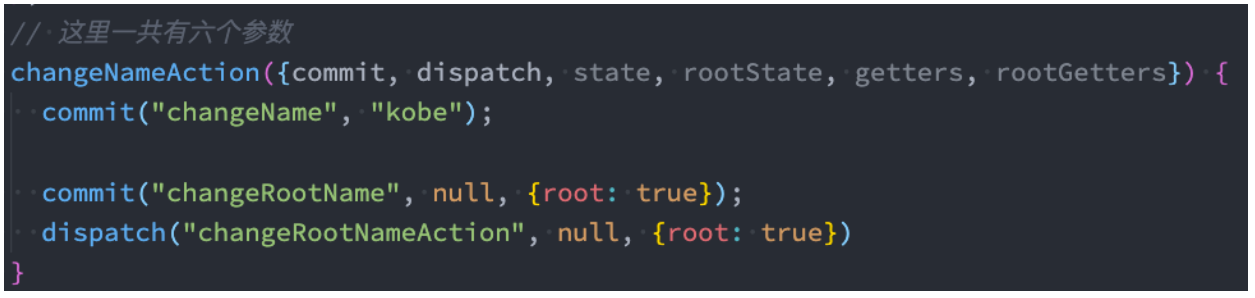
派发给根组件需要加{ root: true },第 2 个参数 null,表示传递给根组件的数据。
这里也解释了为什么 context 对象和 store 对象不是同一个对象,而只是具有相同的方法和属性,在不同的地方 context 代表的含义不一样。